Guides
A Self-Guided Walk Through Brașov's Old Town, Stop by Stop
Tony Denesa – Travel Advisor10 min read
The short version
Brașov's Old Town is best read on foot, in a loop, at a pace that leaves time to look up. This self-guided walk covers about three kilometres and takes two and a half to three hours with stops, or a full morning if you go into the museums. It starts and ends on Piața Sfatului, follows the southern walls under Tâmpa, and climbs to the watchtowers on the northern slope for the view back over the roofs.
- Distance: about 3 km, one short steep climb (the stairs to the White Tower).
- Best time: from 8:30 in the morning, or from 16:00 for the golden-hour finish.
- Shoes: the cobbles are uneven and slippery in rain; leave the heels at the hotel.
- Cost: the walk is free; the Black Church charges 30 lei for adults and the Weavers' Bastion has its own museum ticket (checked September 2026).
The route lies entirely within the Old Town and the edge of Șchei. Numbers below are the stops.
1. Piața Sfatului
Begin in the middle of Piața Sfatului, the Council Square, the market place of the Saxon town the Germans called Kronstadt. The building in the centre is the Council House, the seat of the town magistrates for centuries; its tower served as a lookout, and today the house holds the county history museum and the tourist information centre.
Turn slowly on the spot. On the east side, the arcaded house at number 15 is the Museum of Urban Civilisation, which furnishes each floor in a different century; at number 25, the Mureșenilor House remembers the family of journalists and poets whose verse became Romania's national anthem. The long merchant house on the south-west corner, known as the Hirscher house, was built for a mayor's widow in the 16th century and now holds a restaurant.
2. The Black Church and Honterus
Leave the square by its south-west corner and you are in the churchyard of the Black Church. Walk around the outside first: the buttresses, the unfinished second tower, the statues of saints and apostles weathered almost smooth. Then look for the bronze of Johannes Honterus, pointing at the south door. Honterus, a humanist scholar, founded a gymnasium here in 1533, set up a printing press in 1539 and led the Lutheran Reformation in Transylvania; the school beside the church still carries his name.
Go inside if it is open (Tuesday to Saturday from 10:00, Sunday and Monday from 12:00). The carpets and the Buchholz organ are the highlights; our Black Church guide goes through them. A coffee at CH9, a specialty roaster in the churchyard itself, is a fair reward before you walk on.
3. Strada Sforii
Take Strada Cerbului, parallel to the walls, south-west to the entrance of Strada Sforii, Rope Street. At its narrowest the lane is 1.11 metres wide; it runs 80 metres to Strada Poarta Șchei and was cut in the 17th century so that firefighters could move between the parallel streets. The walls are covered in graffiti and the queue for the photo can be long around midday.
4. Catherine's Gate and the Schei Gate
At the end of Rope Street turn left and walk to the two gates. Catherine's Gate, built in 1559 by the tailors' guild, is the only original gate left; its four corner turrets signalled the town's right to pass capital sentences, and the city's arms, a crown on an oak trunk with roots, are carved on the tower. Next to it, the neoclassical Schei Gate from the late 1820s carried the traffic. For centuries, local tradition holds, the Romanians of Șchei could enter the Saxon town only through these gates, at set hours.
If you have time, detour up Strada Prundului to Piața Unirii for the Orthodox church of St Nicholas and the First Romanian School; the story is in our Șchei guide.
5. The synagogue and Strada După Ziduri
Walk back through the gate and down Strada Poarta Șchei. At number 29 stands the Beth Israel synagogue, built between 1899 and 1901 in a neo-Gothic style with Moorish touches, still an active place of worship. Then turn right into Strada După Ziduri, "Behind the Walls", the lane that runs between the medieval ramparts and the houses of the town. Here the walls are at their most complete, with the Tâmpa forest immediately above. The wine bar Pilvax is on this lane, for later.
6. The Weavers' Bastion and the promenade under Tâmpa
At the end of the lane, the Weavers' Bastion is the finest of the town's surviving bastions: a polygonal tower with three tiers of wooden galleries, defended by the weavers' guild. Inside, a museum of the fortifications has a large model of the 17th-century town, which makes sense of everything you have just walked through. It is a section of the county history museum, closed on Monday.
From the bastion, follow the promenade under Tâmpa, a shaded path along the outside of the walls, towards the lower station of the cable car. If you have energy for a detour, this is where you would go up Tâmpa; our Tâmpa guide explains both ways.
7. Republicii and the north side
Cut back into the centre along Strada Mureșenilor or Michael Weiss and stroll the pedestrian Strada Republicii, the town's main pedestrian street, with its cafés and its view back towards Tâmpa. At its northern end, turn left along the edge of the old town towards the north-western corner of the walls.
8. The Graft Bastion, the White Tower and the Black Tower
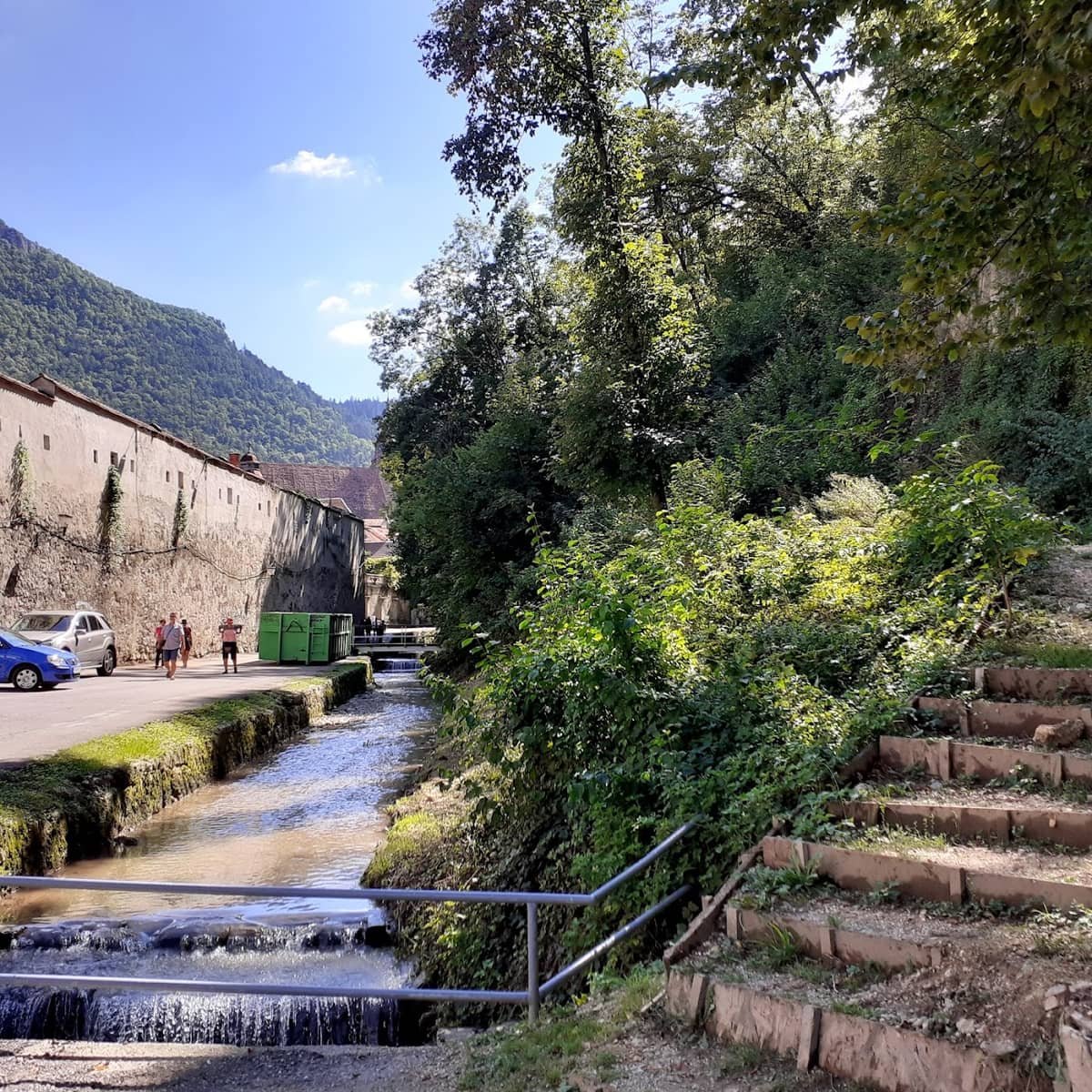
Here the landscape changes: a stream, the Graft, runs along the foot of the Warthe hill, and the Graft Bastion, built between 1515 and 1521, straddles it. From beside the bastion a stair of around 250 steps climbs to the White Tower, a semicircular watchtower level with the church roof. A path along the slope leads on to the Black Tower. The interiors are not regularly open, but the platforms and paths are, and from here, not from Tâmpa, you see the Old Town at eye level with the mountain behind it.
9. Back to the square
Descend the stairs and follow Strada Mureșenilor or Strada Michael Weiss back to Piața Sfatului, fifteen minutes away. You have walked the whole perimeter of medieval Brașov. For dinner nearby, see our restaurant guide; for the story of the fortifications in more detail, our walls and bastions guide.
Practical notes
- Accessibility: the loop is flat except for the tower stairs; skip stop 8 with a pushchair and admire the White Tower from Strada Mureșenilor.
- Rain: the Black Church, the Weavers' Bastion and the Museum of Urban Civilisation make a covered version of the walk.
- Evening: the walls under Tâmpa and the White Tower are lit after dark and the square is lively; the lanes behind the walls are quiet and safe, but take a torch for the tower stairs.
Where to stay nearby
Live prices and availability on a map centred on this exact spot — hotels, apartments and hostels, so you can judge the walk from here rather than guess from an address.
Bookings made through this map earn us a commission. Your price is unaffected.