The city
The Black Church: A Visitor's Guide to Brașov's Gothic Landmark
Tony Denesa – Travel Advisor9 min read
The short version
The Black Church is the building Brașov is known by: a Gothic hall church of dark stone rising from the south-west corner of Piața Sfatului, with a single squat tower and a roof that dominates every view from Tâmpa. It is still the main church of the Lutheran (Evangelical) community of the city, and inside it keeps two treasures most visitors do not expect: one of the largest collections of Anatolian carpets in Europe, and a 19th-century organ with around 4,000 pipes.
- Built: 1383 to 1477, with a long pause after an Ottoman raid in 1421.
- Size: 89 metres long, 38 metres wide, tower 65 metres; room for about 5,000 people.
- Name: from the great fire of 21 April 1689, which blackened the walls.
- Allow: 45 minutes to an hour.
Hours and tickets (bisericaneagra.ro, checked September 2026):
- 1 April to 15 October: Tuesday to Saturday 10:00–19:00; Sunday and Monday 12:00–19:00.
- 16 October to late April: Tuesday to Saturday 10:00–18:00; Sunday and Monday 12:00–18:00.
- Closed on 1 January and 25 December, and for about two hours during concerts, weddings and christenings, announced in advance.
- Tickets: adults 30 lei; seniors and university students 25 lei; pupils under 18, 20 lei; children under 7 free. Several blogs still quote 15 lei; that price is out of date.
- The church is also included in the online Brașov Visit Ticket, which bundles a dozen sites for 90 days.
It stands at the heart of the Old Town, two minutes from Piața Sfatului. The church's own page on our site is the Black Church.
A short history
Brașov was a Saxon town, founded by German-speaking colonists invited to the Bârsa country in the 13th century, and the church was built as its parish church, dedicated to the Virgin Mary. Work began in 1383 on the choir and moved west over almost a century, interrupted when an Ottoman raid in 1421 damaged the town. The result is a hall church, with nave and aisles of the same height, which gives the interior its wide, calm volume.
In the 16th century Brașov became one of the centres of the Reformation in Transylvania. Johannes Honterus, the humanist who founded a school here in 1533 and a printing press in 1539, led the city into Lutheranism; his statue stands outside the south door, and the Honterus school still occupies the churchyard. The church became Lutheran and has remained so, which is why its interior is sober: whitewashed walls, few images, and the carpets as the main decoration.
On 21 April 1689, during the war between the Habsburgs and the Ottomans, a fire swept through the town. The church lost its roof and vaults, and smoke blackened the stone. It was rebuilt over the following decades, with Baroque vaults inside; the name Black Church, Schwarze Kirche in German, stayed.
What to look for outside
Walk around the church before you go in. On the buttresses of the choir, stone statues of saints and apostles have been weathered by six centuries of Carpathian winters; several have been replaced by copies, with originals kept inside. The south tower was meant to have a twin that was never built. On the north side, look for the small figure of a child said to be leaning over the cornice, one of several legends about the builders.
The bell in the tower weighs about six tonnes and is reckoned the third largest in Romania. You will hear it long before you see it if you are on Tâmpa at noon.
Inside: the carpets
The walls and the galleries of the nave are hung with about 110 oriental carpets, most of them Anatolian and most of them woven in the 15th and 16th centuries. Saxon merchants trading with the Ottoman lands brought them home and gave them to the church as offerings and memorials; the guilds bought them for their pews. Together they are described as the largest collection of such carpets outside Istanbul. Look for the types named after European painters who put them in pictures: "Lotto" carpets with yellow arabesque lattices on red, "Holbein" patterns with geometric medallions, and prayer rugs with a niche at one end.
The carpets are fragile and some are rotated for conservation, so do not expect every piece to be on display.
Inside: the organ
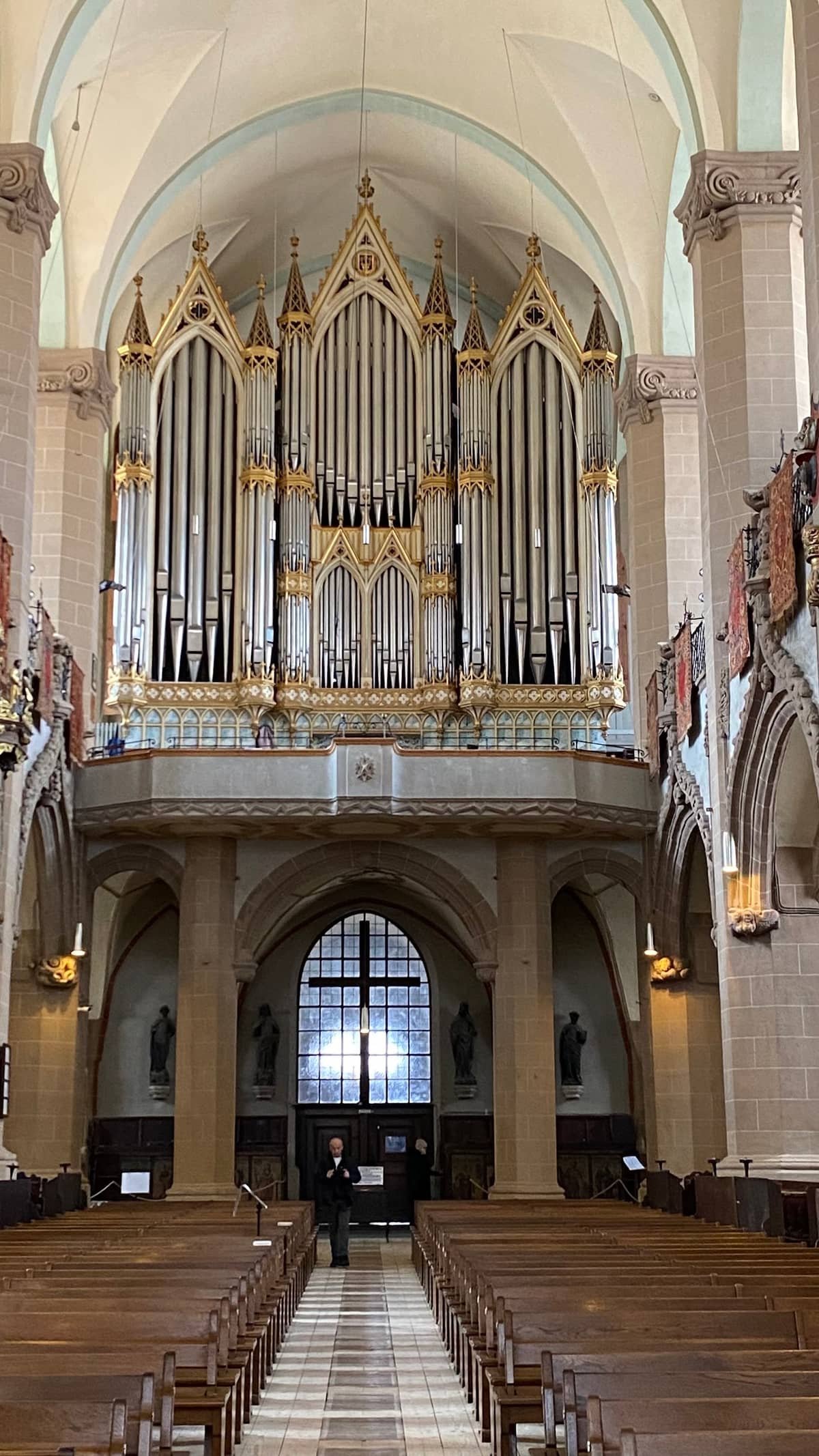
The great organ on the west gallery was built by Carl August Buchholz of Berlin between 1836 and 1839 and inaugurated on 17 April 1839. It has around 4,000 pipes, of which 3,993 survive, and was restored between 1997 and 2001. It is one of the largest historic organs in this part of Europe and one of the few by Buchholz to survive intact. In the summer season the church holds regular organ recitals; the programme is posted on the church's website and at the entrance, and they are the best way to hear the building.
Other details
- Pews and galleries: the guilds had their own benches and galleries, some carved and painted with guild emblems.
- The baptismal font: a bronze font from the 15th century survives from before the fire.
- The lapidarium: original statues and fragments from the exterior, displayed inside so they no longer suffer the weather.
- Photography: rules have changed over the years; ask at the entrance before taking pictures.
Practical advice
- Go early on a weekday. At 10:00 on a Tuesday the church is almost empty; on a Saturday at noon, tour groups fill the nave.
- Sunday and Monday openings start at 12:00; on Sunday the morning is for the service.
- Guided tours in several languages can be requested free of charge by email, subject to availability, through the church's website.
- Combine it with our one-day route or the Old Town walk, which passes the church at stop two, and with a view of its roof from Tâmpa or the White Tower.
Nearby
After the visit, the lanes around the church are full of cafés; CH9 in the churchyard roasts its own coffee. Strada Sforii is three minutes' walk away, and Catherine's Gate five. For lunch, see our restaurants and our guide to what to eat in Brașov. To understand how the church fitted into the fortified town, read Brașov's walls, towers and bastions.
Where to stay nearby
Live prices and availability on a map centred on this exact spot — hotels, apartments and hostels, so you can judge the walk from here rather than guess from an address.
Bookings made through this map earn us a commission. Your price is unaffected.