The city
Șchei and the First Romanian School: Brașov Outside the Walls
Tony Denesa – Travel Advisor9 min read
The short version
Walk through the Schei Gate and you leave Saxon Brașov for another city. Șchei, in Romanian Șcheii Brașovului, is the old Romanian quarter that grew up outside the walls, in the valley that runs south-west under Tâmpa. For centuries its people lived beside the German-speaking town without belonging to it; they built their own church, their own school, their own customs. Today Șchei is a quiet neighbourhood of steep streets, low houses and wooden gates, with one of the most important places in the history of the Romanian language at its heart.
- Where: from the Schei Gate up Strada Prundului to Piața Unirii, about ten minutes on foot from Piața Sfatului.
- Main sights: the church of St Nicholas and the First Romanian School museum, side by side.
- Allow: two hours, including the guided visit.
- Best day: a weekday morning; or the Sunday after Orthodox Easter for the Junii parade.
The neighbourhood page is Șchei; the two main sights are St Nicholas and the First Romanian School.
Two towns in one
Medieval Brașov was a Saxon town. The German-speaking burghers held the walled centre, the guilds and the council; Romanians, like Hungarians and others, lived in suburbs outside the walls. Șchei was the largest of them, a community of carters, shepherds, traders and craftsmen whose links ran south over the mountains to Wallachia. The name is usually traced to an old word for Slavs, a reminder of the valley's earliest settlers, though historians still debate the details.
Relations with the town were hierarchical. Tradition holds that the people of Șchei could enter the walled city only at set hours and through designated gates, and that for a long time they could not own property inside it. That separation explains why Șchei developed its own institutions so early, and why the story of Romanian writing and schooling runs through this valley rather than through the centre.
The church of St Nicholas
In Piața Unirii, behind a wall and a gate tower, stands the Orthodox church of St Nicholas. Local tradition places a wooden church here as early as 1292, and a papal document of 1399 already mentions Orthodox worship in Șchei. The present stone church was begun in 1495 and extended in 1519 with the help of Neagoe Basarab, prince of Wallachia; the bell tower was built at the end of the 16th century. It is a Gothic structure adapted to Orthodox use.
The exterior murals, visible from the courtyard, were painted by Costin Petrescu between 1939 and 1946. In the churchyard are the graves of notable figures of Brașov's Romanian community, among them the diplomat Nicolae Titulescu, whose remains were reburied here. The church is an active parish; dress respectfully and keep silent during services.
The First Romanian School
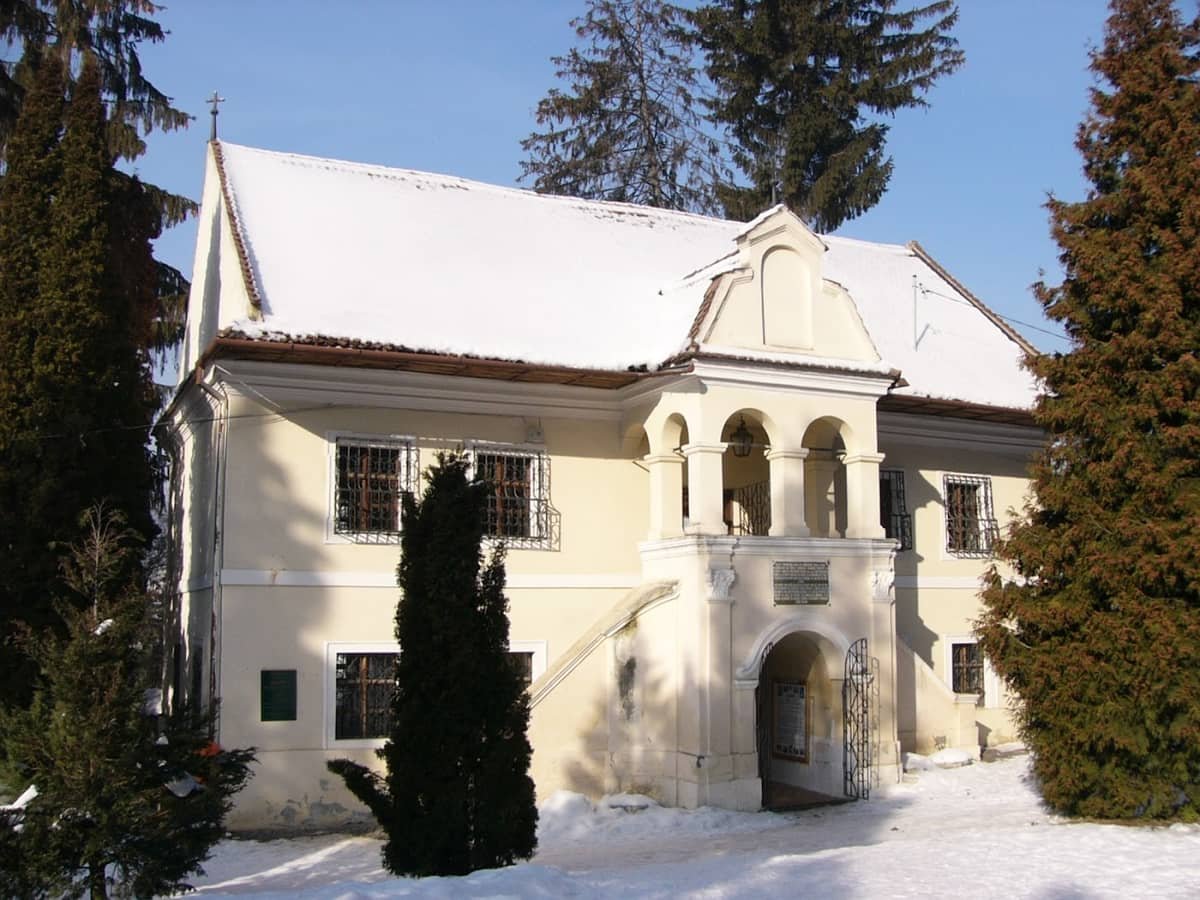
Beside the church, in the same enclosure, is the museum of the First Romanian School. The building dates from the late 15th century, and in 1760 it was given a Baroque upper floor. Here, according to the museum, lessons in Romanian were taught from 1583, when Latin, Greek and Slavonic still dominated learning in the region.
The house also belongs to the history of printing. In the 16th century deacon Coresi, a printer from Târgoviște, worked in Brașov and produced some of the first books in the Romanian language, including religious texts that helped fix the written language. A reconstructed press stands in the museum. Later, in 1757, Dimitrie Eustatievici of Brașov wrote the first grammar of Romanian here.
The museum spreads over around thirty rooms, with a reconstructed 19th-century classroom named after the poet and composer Anton Pann, old books and manuscripts, school documents and church objects.
Visiting (checked September 2026):
- Tickets: adults 20 lei, reduced 10 lei; the museum is also part of the Brașov Visit Ticket.
- Guided visits only, lasting 30 to 40 minutes. Individual visitors should phone ahead, as groups have priority and times vary; published hours differ between sources, so confirm on the day.
- Photography rules and English-language guiding depend on the guide available.
The Junii of Brașov
Șchei is also the home of the Junii, the young men of the quarter organised in seven groups: Junii Tineri, Junii Bătrâni, Curcanii, Dorobanții, Brașovechenii, Roșiorii and Albiorii. Their customs are first documented in 1728. On the Sunday after Orthodox Easter, Duminica Tomii, they ride on horseback in costume from Piața Unirii, through the centre and Piața Sfatului, and out to Solomon's Rocks, a gorge at the top of the valley, where the festivities continue. The parade leaves Piața Unirii at about 11:00; in 2027 it falls on Sunday 9 May. It is free and it is the best day of the year to see Șchei, and the most crowded. Check our events page nearer the date.
A walk through Șchei
- Start at the Schei Gate and Catherine's Gate, at the edge of the old town.
- Walk up Strada Prundului, the quarter's spine, lined with low houses and courtyards.
- Visit St Nicholas and the First Romanian School in Piața Unirii; look for the bust of the composer Ciprian Porumbescu nearby.
- Continue up the valley to Solomon's Rocks, about half an hour further on foot, a picnic spot among limestone cliffs, and return the same way.
- On the way back, take any of the steep side streets towards Tâmpa for views of the rooftops.
Lunch options in and around Șchei are listed in our restaurants; guesthouses in the quarter are in where to stay.
Why it matters
Brașov is often presented as a Saxon town, and its centre is. But the city's Romanian story, the story of a language learning to write itself down, is told in Șchei. Visiting both gives you the whole of Brașov: the walled town and the town outside the walls. Pair this walk with our Black Church guide and the Old Town walk to see the two halves on one day.
Where to stay nearby
Live prices and availability on a map centred on this exact spot — hotels, apartments and hostels, so you can judge the walk from here rather than guess from an address.
Bookings made through this map earn us a commission. Your price is unaffected.