The city
Brașov's Walls, Towers and Bastions: Walking the Medieval Defences
Tony Denesa – Travel Advisor9 min read
The short version
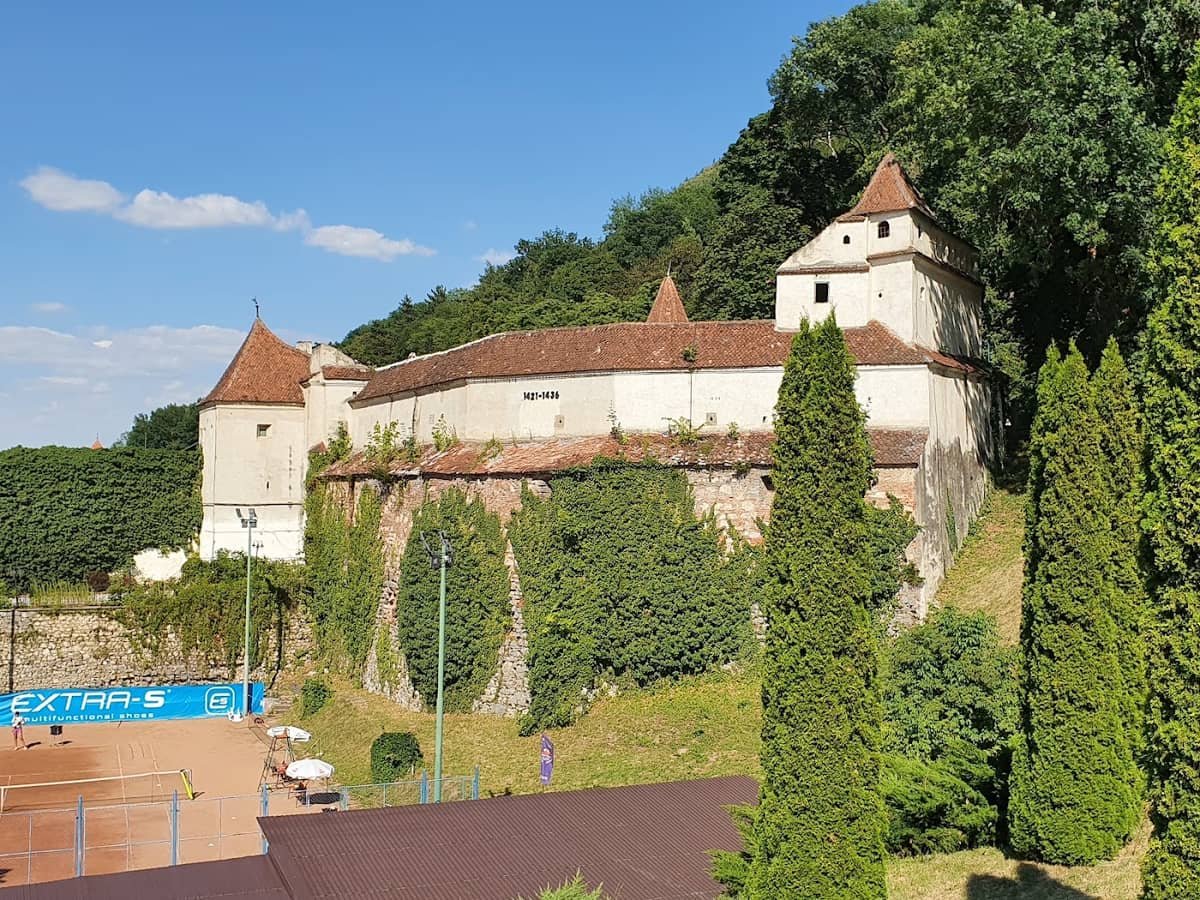
Medieval Brașov was a fortress town. Its Saxon burghers ringed the centre with walls, gates, towers and bastions, and each guild took charge of defending its own stretch. Much of that ring is gone, pulled down in the 19th century as the city grew, but the southern and western sides survive almost complete, pressed against the forest of Tâmpa, and a handful of towers still stand on the hills to the north. Walking them is the best way to understand how the city worked.
- Best preserved: the southern walls along Strada După Ziduri, with the Weavers' Bastion.
- Best views: the White Tower and the Black Tower, on the slope north-west of the centre.
- Only original gate: Catherine's Gate, 1559.
- Time: about two hours for the full circuit on foot, more with the museum.
Everything below is in or around the Old Town. If you want a ready-made route, our Old Town walk follows the same line.
Why a walled town
The Saxons who settled the Bârsa country from the 13th century lived on a frontier. Tatar raids, and from the 15th century the Ottoman armies crossing the Carpathian passes, made fortification a matter of survival. Brașov had an older refuge, the Brasovia citadel on the summit of Tâmpa, demolished in the 15th century; the town itself was enclosed step by step through the 14th and 15th centuries, and the defences were strengthened again in the 16th and 17th, when artillery demanded thicker walls and projecting bastions.
The system was civic rather than royal. Each guild, from weavers and tailors to blacksmiths and rope-makers, maintained a bastion or tower, stored arms there and manned it in time of siege. The names survive in the bastions you can still see.
The Weavers' Bastion
The Weavers' Bastion, at the southern corner of the walls, near Șchei, is the most complete. Its polygonal body rises in several storeys of wooden galleries with loopholes, built and defended by the weavers' guild. Inside is the museum of the town's fortifications and of the fortified churches of the Bârsa country, a section of the county history museum. Its centrepiece is a large model of Brașov in the 17th century, with every wall, moat and gate in place, which makes sense of what remains.
The museum is included in the county's unified museum ticket (adults 25 lei, valid 15 days, sold at museum desks) and in the online Brașov Visit Ticket (both checked September 2026). Like the other county history museum sections, it is closed on Monday; check hours before you go.
Strada După Ziduri and the promenade under Tâmpa
From the bastion, two parallel paths run along the walls under Tâmpa. Inside, Strada După Ziduri, "Behind the Walls", is a lane between the rampart and the backs of the town houses, the most atmospheric stretch in the city. Outside, the promenade under Tâmpa follows the foot of the mountain under old trees, past the moat line and the lower station of the cable car.
This is where the wall is at its most continuous, with stretches of crenellation, loopholes and remains of smaller towers. The forest comes right down to it, which is why the southern walls were never demolished: there was nowhere for the city to grow.
The gates
Of the town's historic gates, only one survives from the Middle Ages. Catherine's Gate was built in 1559 by the tailors' guild, replacing an earlier gate damaged by floods. Its slim tower with four corner turrets was a statement: the turrets signalled the town's right of *ius gladii*, the power to judge and to execute. The coat of arms, a crown on an oak trunk with roots, is carved on it.
Next to it, the Schei Gate is a neoclassical arch from the late 1820s, built when traffic between the town and Șchei outgrew the old gate. The story of the quarter beyond is in our Șchei guide.
The Graft Bastion
On the north-western side, the walls met a problem: a stream, the Graft, running at the foot of the Warthe hill. The Graft Bastion, built between 1515 and 1521, straddles the watercourse on an arch, so that the defenders could control both the stream and the path along it. It is one of the most photographed corners of the city, especially with the White Tower above it.
The White Tower and the Black Tower
On the slope above the Graft stand two watchtowers, outposts that could fire over the walls and watch the approaches from the north.
The White Tower, a semicircular tower, sits high above the Graft Bastion and was linked to it by a bridge. A stair of around 250 steps now climbs to its platform, which offers the finest view of the Old Town at eye level: the Black Church, the square and Tâmpa behind.
The Black Tower, further along the same slope, is smaller and square; its name is usually linked to a lightning fire that blackened it centuries ago. A path connects the two. Neither interior is regularly open to visitors, but the platforms and paths are free and accessible at any reasonable hour.
Beyond the walls: the fortress on Straja hill
North of the centre, on the wooded Straja hill, the Cetățuia is a small fortress of the 16th century, built to watch over the town and later used as a barracks and a prison. It has been a restaurant since the 1980s and its interior opens only occasionally for events, but the path around its walls and the viewpoint are free, and quieter than the towers.
Walking the circuit
- Start at Catherine's Gate and follow the walls and Strada După Ziduri to the Weavers' Bastion.
- Visit the museum, then return along the promenade under Tâmpa to the cable car station.
- Cross the centre via Strada Republicii to the Graft Bastion.
- Climb to the White Tower, walk on to the Black Tower, and come down to Strada Mureșenilor.
- If you have time, cross to Straja hill for the Cetățuia.
Allow two hours, plus an hour for the museum. For the view of the whole ring at once, go up Tâmpa first. And for the town inside the walls, start with our Black Church guide and our castles and fortified churches, which show how the villages of the Bârsa country defended themselves in the same centuries.
Where to stay nearby
Live prices and availability on a map centred on this exact spot — hotels, apartments and hostels, so you can judge the walk from here rather than guess from an address.
Bookings made through this map earn us a commission. Your price is unaffected.